

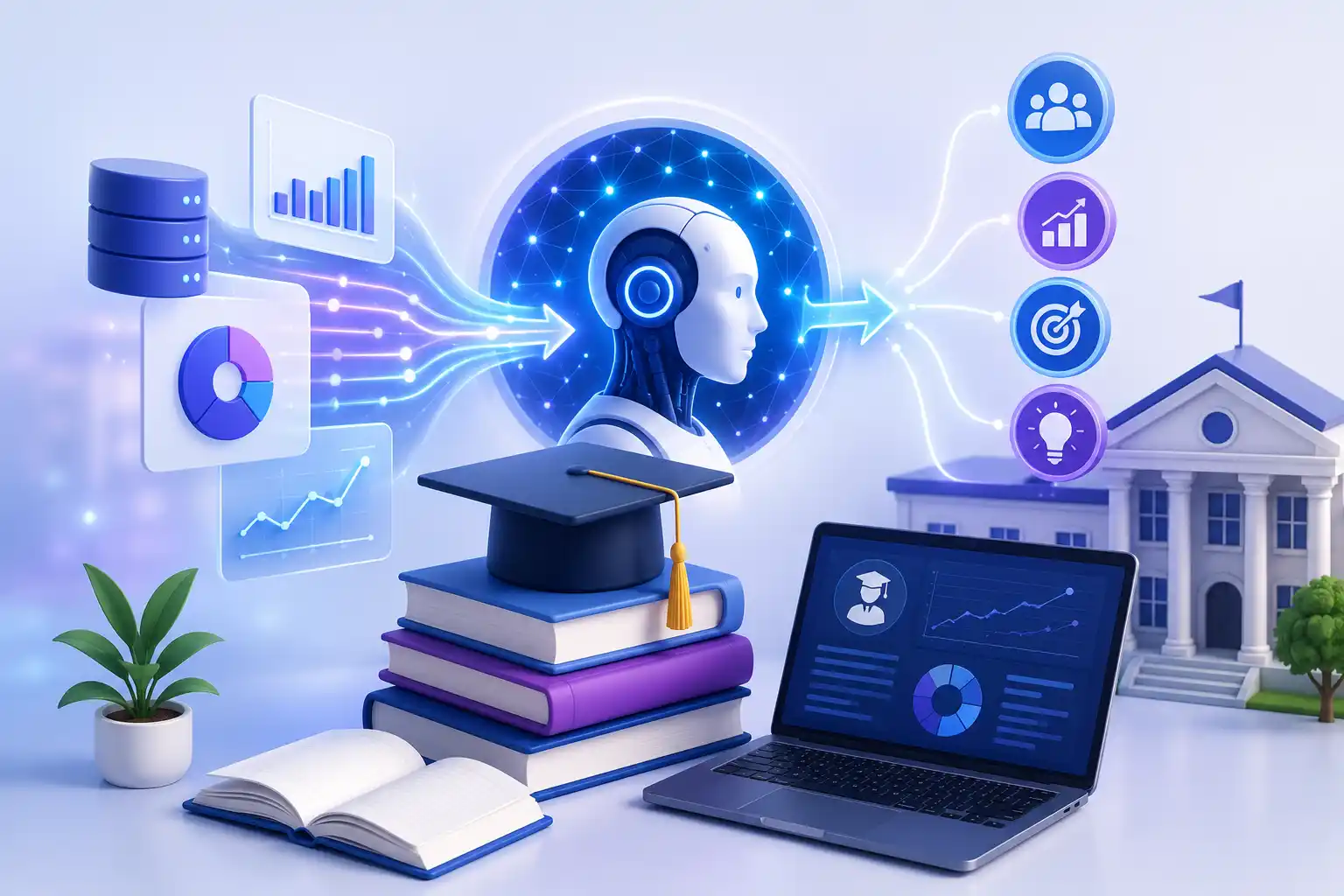
From Data to Decisions: The Role of AI in Next-Gen Education Management
Discover how AI-powered college ERP software transforms academic administration, streamlines campus operations, and enables educational institutions to make smarter, data-driven decisions.
Table of Contents
- Introduction
- Can AI Bring All Academic and Administrative Data Together?
- How Can AI Reduce the Administrative Load on Faculty and Staff?
- Can Financial and Resource Management Become Smarter with AI?
- How Does AI Improve Communication and Stakeholder Engagement?
- Can Data Predict Challenges Before They Escalate?
- Are AI Systems Secure and Scalable for the Long Term?
- Final Thoughts
Introduction
Today's higher education institutions require intelligent digital solutions to streamline academic management, student services, examinations, finance, and campus operations. From admissions and academics to examinations, finance, communication, and accreditation, managing everything manually can become complex and time-consuming. A modern college management system powered by AI in education helps institutions convert data into meaningful insights while automating everyday operations. Whether you're using an ERP for colleges or a comprehensive campus management system, AI enables institutions to improve efficiency, transparency, and decision-making across every level.
Can AI Bring All Academic and Administrative Data Together?
Educational institutions often use multiple applications for admissions, academics, examinations, finance, and HR. This creates data silos, duplicate records, and inconsistent reporting. An AI-powered education management system brings all institutional data into a centralized platform, providing administrators with a complete view of campus operations.
Solutions like HiGrade, an AI-powered college management system, bring student, faculty, academic, financial, and administrative data together on a single platform. By eliminating disconnected systems, HiGrade helps institutions improve collaboration, streamline campus operations, and make faster, data-driven decisions.
With intelligent college management software, institutions can:
- Centralize student, faculty, and academic records
- Eliminate duplicate data and manual reconciliation
- Access real-time reports from a single dashboard
- Improve collaboration across departments and campuses
This unified approach enables faster decision-making while improving data accuracy and operational efficiency.
How Can AI Reduce the Administrative Load on Faculty and Staff?
Administrative tasks consume valuable time that could otherwise be spent improving teaching and student engagement. An AI-enabled ERP for colleges automates repetitive workflows and simplifies institutional operations.
AI-Powered Academic Automation
HiGrade automates repetitive academic and administrative tasks, helping institutions improve operational efficiency, reduce manual effort, and provide a better experience for students and faculty.
By automating these routine activities, a college ERP software reduces manual errors, improves productivity, and allows faculty and administrators to focus on delivering better educational outcomes.
Can Financial and Resource Management Become Smarter with AI?
Financial management is more than collecting fees—it requires complete visibility into institutional revenue, expenses, payroll, scholarships, and budgeting. A modern education management system combines financial automation with AI-driven analytics to support smarter resource planning.
AI helps institutions:
- Monitor fee collections and outstanding payments.
- Analyze expenditure patterns.
- Detect unusual financial activities.
- Improve budgeting and audit readiness.
With an intelligent college management system, finance teams can make data-driven decisions while maintaining compliance and transparency.
How Does AI Improve Communication and Stakeholder Engagement?
Effective communication is essential for creating a connected campus. AI-powered campus management systems automate notifications and ensure the right information reaches the right audience at the right time.
Students, faculty, parents, and administrators can receive real-time updates for:
- Attendance alerts
- Examination schedules
- Academic results
- Fee reminders
- Events and announcements
Integrated web portals and mobile applications further improve engagement by providing secure, anytime access to institutional information.
Can Data Predict Challenges Before They Escalate?
One of the biggest advantages of AI in education is predictive analytics. Rather than simply reporting historical information, AI helps institutions identify future risks and opportunities.
An AI-powered college ERP software can analyze the following:
- Student attendance trends
- Academic performance patterns
- Faculty workload
- Classroom utilization
- Resource allocation
These insights allow institutional leaders to intervene early, improve student success, and make strategic decisions backed by reliable data.
Are AI Systems Secure and Scalable for the Long Term?
As institutions grow, technology must evolve alongside them. A scalable education management system is designed to support multiple departments, campuses, and academic programs while maintaining strong security standards.
Modern college management software provides the following:
- Secure cloud infrastructure
- Role-based user access
- Automated data backups
- Multi-campus management
- Real-time data synchronization
- Compliance with institutional standards
This ensures institutions can confidently expand their digital ecosystem without compromising security or performance.
Final Thought
The future of higher education lies in transforming data into meaningful decisions. An AI-powered college management system not only automates administrative and academic processes but also delivers valuable insights that help institutions improve efficiency, communication, financial management, and student success.
By adopting a modern ERP for colleges, institutions can streamline operations, strengthen academic management, enhance the student management system, and create a smarter, more connected campus. As AI in education continues to evolve, educational institutions that embrace intelligent college ERP software will be better equipped to meet future challenges and deliver exceptional learning experiences.